On a X Spaces spat, Palestine and Iraq, and a bit about me
Ahlan wa sahlan
Recently, a spat occurred between some diaspora Palestinians on an X (Twitter) Space. Without going into too much detail, it ended with a couple of Palestinians calling another Palestinian not really (or not a real Palestinian), because she’s half-Palestinian, and by extension her voice on Palestine is diminished.
The strange thing was, the other half of the Palestinian in question was mentioned or even considered; she’s actually half-Palestinian, half-Iraqi. Could there be a better mix? I say as a half-English and half-Iraqi.
Personally, with my more distant mix, I’ve always found Iraqis positively highlighting my Iraqiness (the side of me that is familiar to them): “Your father is from Iraq? Ahhh, you’re Iraqi!” On the other hand, English people (and other Westerners) will often highlight my Iraqi side over my English one. Although this is not always in the bad, ‘othering’ way, I can certainly say that I’m not seen as English by them and am even quite often referred to as Iraqi.
The point here is that, while one side (the English) often stresses the difference, the other (Iraqis) highlights the familiar.
Conversely, when it comes to my ‘other’ side, I’ve found Iraqis to be more accepting. Despite everything that has happened between the UK and Iraq, they geneally maintain a positive view of British life and the British, while seeing the difference between the actions of the British government and the nature of the people. On the other hand, this distinction is not so well realized by a lot of my British counterparts; I don’t know how many times I’ve been asked if my dad was an arms dealer (more of a 90s thing) or been called (jokingly, sometimes) a terrorist. I’m sure you know all the tropes.
So, when it comes to the aforementioned spat, I’d hope to see unity and kinship prevail, as seems to be the Arab way. Incidentally, this would also be a good way to dispose of that other Western trope of Arabs being inherently divided.
United cause: Palestine and Iraq
I’ve always thought that Palestinians and Iraqis to be untied in some way, and not just along Arab lines, but, unfortunately, due to their suffering, which although not exactly the same does stem from the same dehumanisation.
A while ago on X, I illustrated this by way of an infographic detailing how Iraqis and Palestinians, via their dehumanisation, have had consent for massive collateral damage and genocide manufactured against them; Iraq during the nineteen-nineties Gulf War and Palestine after October 7.
The infographic does not need much explanation and is reproduced below:
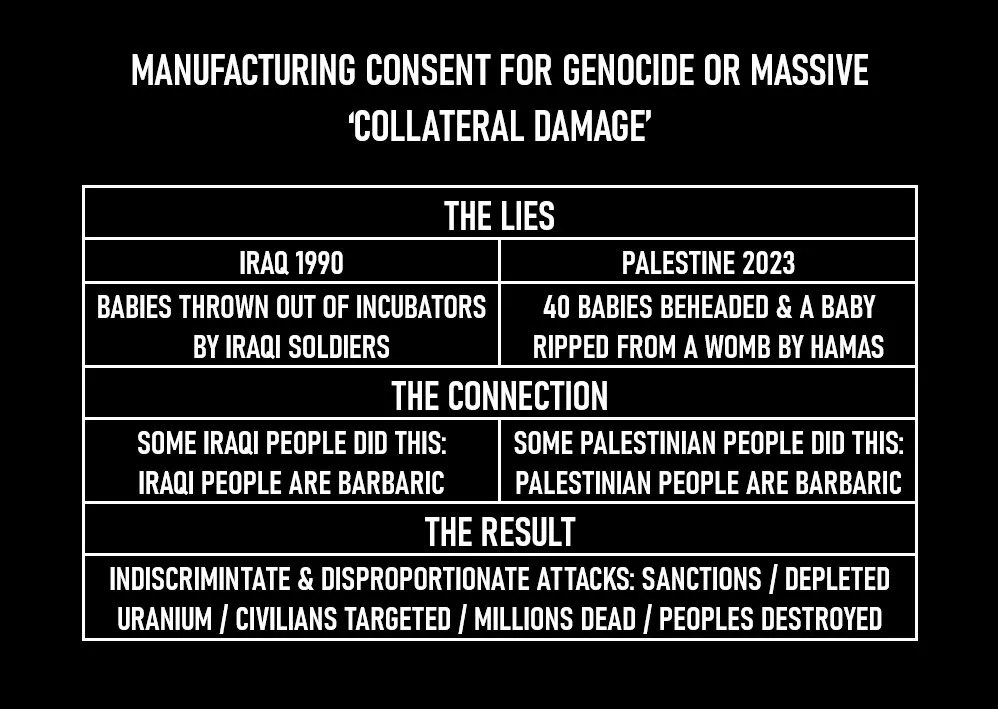
Iraqis and Palestinians (and many others) suffer as a result of dehumanisation, and this should be a focus for unity and in turn a source of strength. That is to simply say, division will get us nowhere.
Finally, another note on unity, maybe a more positive, and constructive one. Since October 7, a popular trope from anti-Palestinians and Zionists has been to claim that the Keffiyeh is not actually Palestinian, but Iraqi in origin and that it has been appropriated, or stolen, by Palestinians. For my views on the topic see my below post:
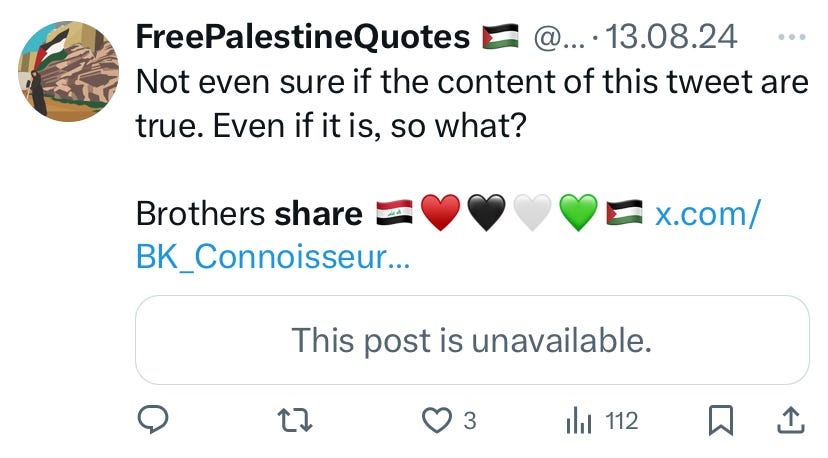
Unfortunately the original post has been deleted; I need to get better at screenshotting Zionist posts before shaming them into scrubbing the record.
Interestingly, the Keffiyah claim is actually a clap back at the fact that Israelis literally steal and claim Palestinian culture as their own, especially food. I’m sure most are familiar with the Israeli social media posts of bastardised putrid-coloured hummus and limp-looking fatoush salads.
All I want to say here is: Colonisers steal, while brothers, sisters and cousins share. And, if the Keffiyah is originally Iraqi, both Palestinians and Iraqis can be proud that it is synonymous with the Palestinian struggle, coming from a place that has suffered alongside Palestine and is in need of its own kind of liberation.
 peaceinthestreets