Traditional Society
In Land Before Honour: Palestinian Women in The Occupied Territories, Kitty Warnock tells the experiences of Palestinian women living in the Israeli-occupied Palestinian territories of Gaza and the West Bank. [1] Through interviews with women of all ages and social backgrounds, Warnock provides vital insights beyond the Orientalist conceptions of Palestinian women and media coverage that typically reduces Palestinians to terrorists or refugees.
However, this book doesn’t only focus on the issues that Palestinian women face as a result of Israel’s occupation. It also considers a pertinent issue to the whole region: the position of women in their own ‘traditional’ society. This makes the book double-essential reading, in particular when considering what should come first, the liberation of Palestine or the liberation of its women.
Traditional society, which is not particular to any religion (Christianity or Islam) or sub-culture in Palestine and which has similarities with other cultures in the Mediterranean region, represents a framework of ideals that places restrictions on women.
Central to this is the notion of honour, in particular the honour of the family in the eyes of the community. Because the family is a “structure through which men relate to the world”, the idea of honour mostly pertains to qualities and virtues decided by men. As such men are portrayed as the active defenders of honour while women are largely its passive objects: men are seen as the protectors of women who in turn are portrayed as being in need of protection. Stemming from this is an ideological pressure to keep women as helpless and dependent on men as possible.[2]
As a result women are largely confined to the domestic sphere with their freedoms and rights curtailed; their freedom to work, their freedom of movement, their freedom to choose a husband and so on. Although becoming somewhat relaxed over time, this is a system that has not fundamentally changed.[3]
Changes
While some changes have been forthcoming there is often a caveat attached. For example, although Palestinian women have become more likely to go out and work, they tend to be channeled into typically ‘feminine’ jobs, which are mostly classified as unskilled or semi-skilled, poorly paid and easily replaceable. In terms of education, while young Palestinian women have become more represented in schools and universities, male children are favoured for any universities placements abroad.
The book shows that the changes that have taken place are not experienced by all Palestinian women. Generally speaking, wealthier and more urban woman have seen more of an improvement in their position than their poorer counterparts and women living in rural areas.
In terms of how the changes have come about, aside from education itself, the author notes economic changes beginning in the nineteenth century when Ottoman reforms eroded the old land-based subsistence farming economy and the hierarchical system that went with it. Further economic development since then has seen an improvement of women’s status within marriage and reduced their dependence on their husbands and confinement to child bearing and domestic work.[4] A rising material standard of living has also reduced women’s domestic burden giving them more time for leisure.
While these changes amount to an improvement for many women with regards to the traditional society of old, there has not been much of a move away from the patriarchal family structure:
“Women would be educated, comfortable, respected and not ill-treated at home, perhaps successful at work, perhaps the companions and friends of their husbands and sharers in economic power and decision making; but with all this they would still be ultimately subordinate, and every aspect of their lives would be subordinated to their role of wives and mothers”[5]
Nevertheless changes have taken place, but they did not simply occur as the representation of women in formal education increased and the economic situation of Palestine developed. The changes were the result of women coming together, organising themselves and demanding more freedom. A process which also involved defying certain social norms along the way.
With a range of possibilities open to Palestinian women that their mothers and grandmothers did not have, the challenge now is for women to perceive these possibilities and push them further as well as taking them to their less fortunate sisters.[6]
Double-edged swords
In the 1970s an Islamic ‘revival’ took place in the Occupied Territories. This was largely against the political, economic, cultural domination of the West, which was presented as a threat to morality and the traditional family model.[7] However, the movement does not necessarily represent a return to ‘tradition’. Because of this the author notes a certain appeal of Islam to some Palestinian women seeking betterment in their lives.
Rather than subscribing to the interpretations of Islam that have developed over the centuries, some women in Palestine focus on a ‘pure’ Islam that emphasises teachings that recognise women’s rights and value in society.[8] This interpretation of Islam can provide a step forward away from women’s place in traditional society, albeit in a paradigm that ultimately confines and subordinates them to a certain role.
Of course there are some that see Islam as inherently hostile to women and as obstacle to be overcome in their quest for equality. Nevertheless, the views of Muslim feminists are represented in the book and their aims are not dissimilar to their secular sisters: to be educated, to work, to be responsible for their own sexuality and not requiring male ‘protection’.
****
It may be tempting to think that the various upheavals that Palestinians have experienced during their conflict with Israel have only held back the advancement of women’s rights. While it should be in no doubt that these events have severely damaged and hindered Palestine’s economic, political and societal development, when it comes to women’s rights the situation is not so straightforward.
In the face of the adversity meted upon their people, Palestinian women have mobilised and organised themselves to provide for and tend to a stricken society, while a few women have even taken up arms. The Palestinian loss in the Arab-Israeli War of 1948 and the occupation of the West Bank since 1967 and Gaza from 1967 to 2005 have forced women to act and men to accept the fact.
The two areas where women have fared better over the years (education and work) also have a connection to Palestine’s turbulent history. Following 1948, the need for education in Palestine became more urgent, with Palestinians seeing education as a political weapon to confront Israel with.[9] In terms of more female representation in the workforce, this is often out of necessity due to the absence of a male figure in the household as a result of the conflict with Israel.
On a more every day level, Palestinian sons and daughters are now largely free to choose their own spouses. In the prevailing climate of violence and fear of a society under occupation, the upholding of traditions for some parents is less important than the happiness of their children.[10] On the other hand, traditional society can be strengthened under such circumstances – either as a response to the threat of Palestine’s very existence, or as a result of the damage to the perceived honour of men at the hands of Israel, or as a need to protect, and therefore seclude, women from a hostile occupying force.
So what should come first: the liberation of Palestine or the liberation of its women from their own society? In my opinion: both.
In their own words
What really makes this book are the interviews. It is here that we get to know Palestinian women from many walks of life. The intimate details in the interviews are what really give Palestinian women a voice to counter the Orientalist and media narratives that ultimately harm them.
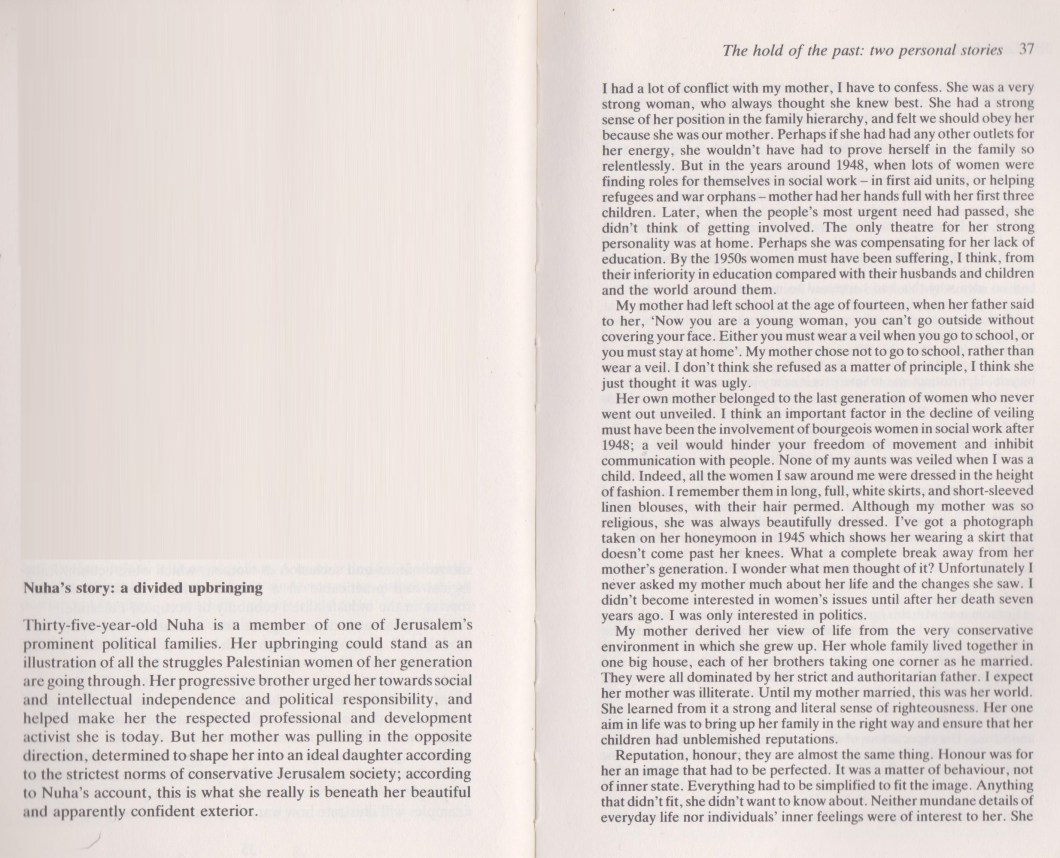
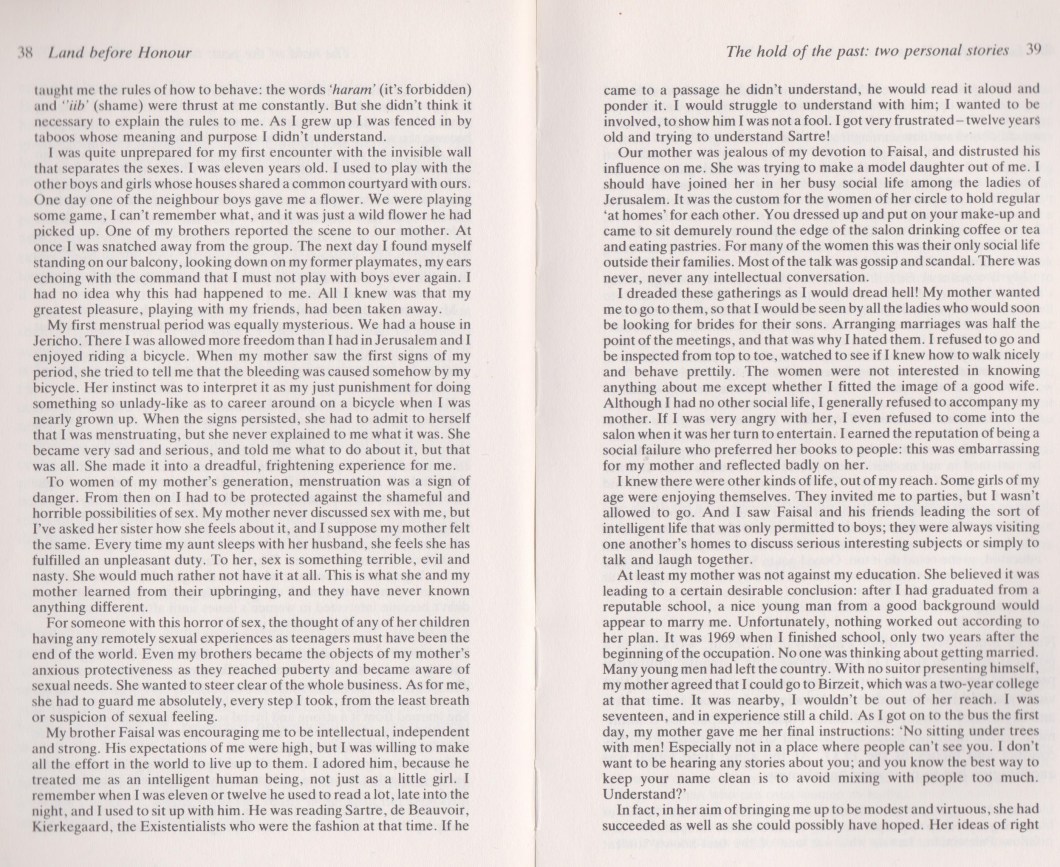
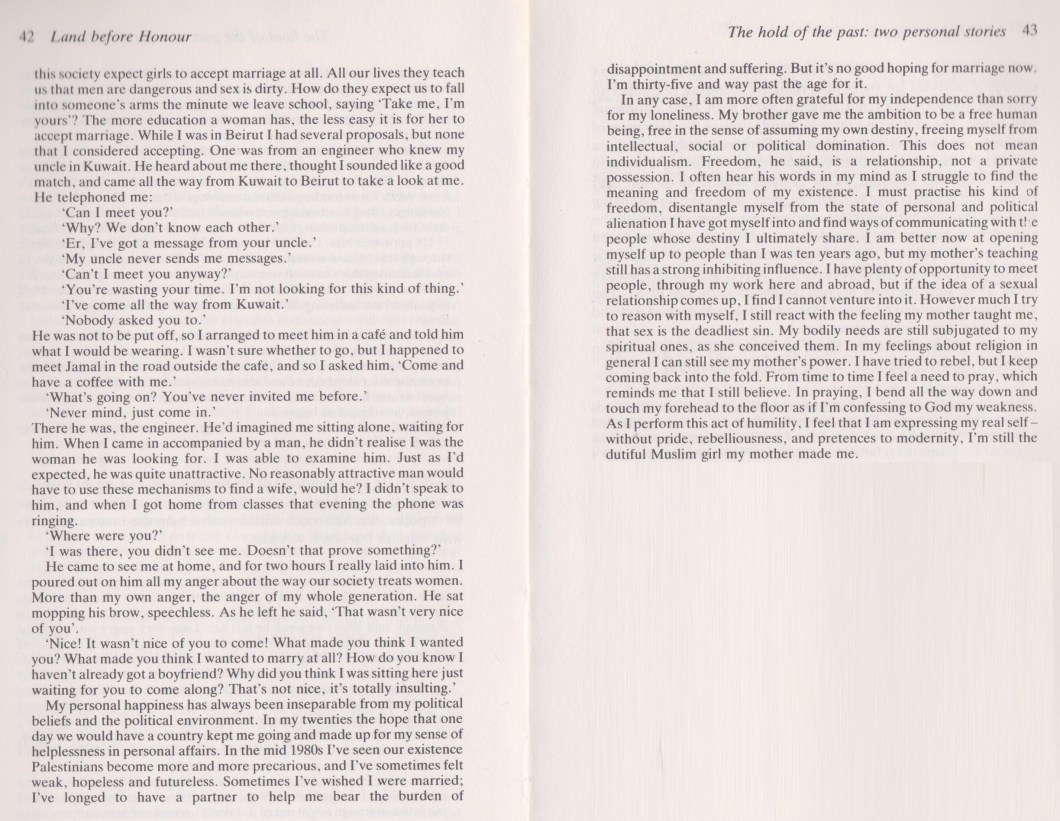
Below I have provided one of the interviews in its entirety. The story of 35 year old Nuha from Jerusalem.
The interview is taken from chapter two of the book: The hold of the past

Footnotes
[1] At the time of publication Gaza had been under Israeli civilian and military occupation since 1967. Although, Israel withdrew in 2005, it is still claimed that through control of Gaza’s borders, airspace and waters, Israel still occupies the territory.
[2] Kitty Warnock (1990: 20) Land Before Honour: Palestinian Women in the Occupied Territories
[3] Ibid., 20
[4] Kitty Warnock (1990: 173) Land Before Honour: Palestinian Women in the Occupied Territories
[5] Ibid., 182
[6] Ibid., 64
[7] Ibid., 64 – 66
[8] Ibid., 66
[9] Ibid., 81
[10] Ibid., 63
 peaceinthestreets