
On December 6, 2017, US President Donald Trump announced the United States’ recognition of Jerusalem as the capital of Israel and ordered the relocation of the U.S. Embassy in Israel from Tel Aviv to Jerusalem, stating:
“I have determined that it is time to officially recognize Jerusalem as the capital of Israel … While previous presidents have made this a major campaign promise, they failed to deliver. Today, I am delivering.”[1]
By way of assurance to the Palestinians, Trump stressed that he was not stipulating how much of Jerusalem should be considered Israel’s capital and did not rule out a future division of the city.[2]
Nevertheless, a day later the United Nations Security Council held an emergency meeting in which 14 out of the 15 members voted to condemn Trump’s decision, only for the motion to be vetoed by the United States. The Palestinians of course opposed the move, as did most of the international community.[3]
So, why did Trump’s announcement prove so controversial?
Jerusalem is a disputed city with both the Palestinians and Israelis claiming it as their capital. While it is generally accepted that East Jerusalem would serve as the capital of a future Palestinian state, leaving West Jerusalem for Israel, any final status regarding the city is to be determined through the peace process.
The situation, however, is complicated by the fact that East Jerusalem has been under Israeli military occupation since the 1967 Six Day War, and more so when Israeli civilian settlement through evictions of Palestinian residents in East Jerusalem are considered.
The international community regards Israeli civilian settlements in the West Bank (including East Jerusalem) to be a contravention of international law, an interpretation that Israel rejects. Legal disputes aside, Israel’s settlement program in the West Bank represent the biggest hindrance to Palestinian development both politically and economically.
Furthermore, Israeli settlements have resulted in the effective annexation of large areas of land that should one day be part of a Palestinian state. Indeed, Israel’s settlement program is still expanding with no effective opposition from President Trump and his government. For this reason, Trump’s apparent assurance to not rule out any future division of Jerusalem rings hollow at best. At worst, prophetic of a future division in Israel’s favour.
The rhetoric coming from the White House and Israel throughout this saga hardly makes reference to the Palestinians, nor does it specifically define West Jerusalem as Israel’s capital. In response to Trump’s original announcement in December 2017 nearly all of the opposition declared that if West Jerusalem should be the capital for the state of Israel then East Jerusalem should be the capital for the state of Palestine.
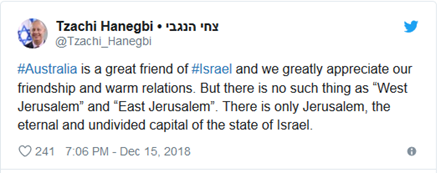
More recently, Australia, a country that has not particularly opposed Trump’s declaration, formally recognised West Jerusalem as Israel’s capital. The response from Israel’s Minister for Regional Cooperation, Tzachi Hanegbi of the Likud Party was that:
*****
On July 23, 2019 Jason Greenblatt, Trump’s peace envoy to the Middle East, stated that the Palestinian claim to East Jerusalem as its capital was an aspiration and not a right. He then went on to say that “aspirations belong at the negotiating table. And only direct negotiations between Israel and the Palestinians can resolve the issue of Jerusalem, if it can be resolved.”[4]
Curiously, Greenblatt is half-echoing the Palestinian view on Jerusalem, which according to the Palestinian chief negotiator, Saeb Erekat is that, “All of Jerusalem remains a final-status issue for negotiations, while East Jerusalem, under international law, is an integral part of the occupied Palestinian territory.”[5]
In terms of human rights, they only become rights upon their realisation. In declaring Jerusalem the capital of Israel, Donald Trump made Israeli aspirations to have Jerusalem as its capital effectively a right.
Since the mid-1970s, rather than the United Nations, it is the President of the United States that has been the main broker for peace in the Israel-Palestine conflict. During this time the United States, as a permanent member of the United Nations Security Council, has further undermined the authority of the United Nations by vetoing resolution after resolution calling for Israel to abide by international law.
The support given by the US to Israel has massively hindered the application of international law and has allowed Israel to ignore consensus among the international community for decades. The dynamic enabled by the US is one which sees Israel rewarded despite its failing in the peace process and the Palestinians, if not punished, having any recognition of their rights deferred indefinitely. This is a dynamic that only results in more conflict and with it the slow death of the Palestinians as a nation.
In short, what the President of the United States says matters.
Footnotes
[1] https://twitter.com/realdonaldtrump/status/938517073508163584?lang=en
[2] https://www.theguardian.com/us-news/2017/dec/06/donald-trump-us-jerusalem-israel-capital
[3] In a subsequent UN General Assembly vote on December, 21, 2017 a non-binding resolution was passed (128 for, 9 against, 35 abstentions) calling for the United States to drop its recent recognition of Jerusalem as Israel’s capital.
[4] https://www.jta.org/quick-reads/trump-peace-envoy-palestinians-do-not-have-a-right-to-a-jerusalem-capital
[5] https://www.theguardian.com/world/2018/dec/16/israel-chides-australias-recognition-of-west-jerusalem-as-capital
 peaceinthestreets